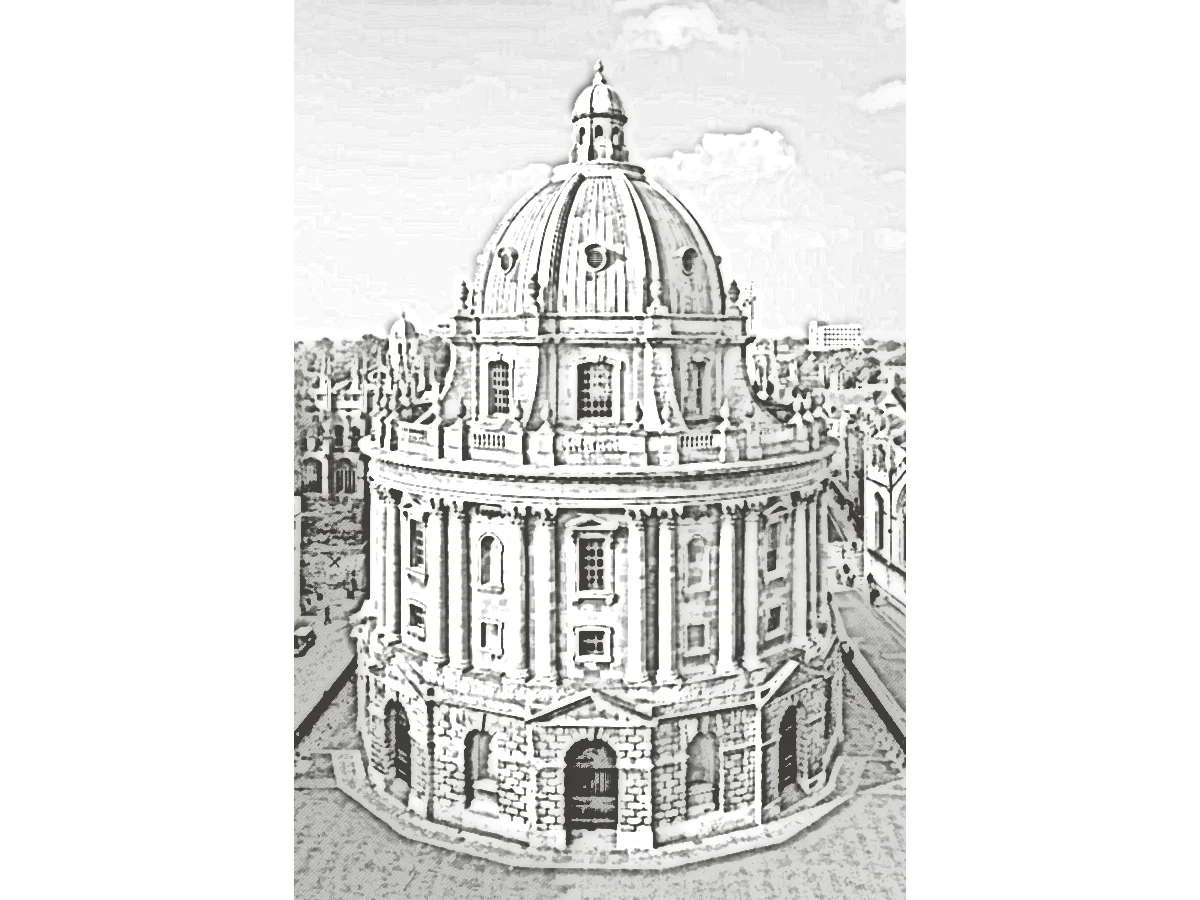
Radcliffe Camera, University of Oxford. Line rendering after a photograph; date and credits at source. Diliff.CC BY 2.5 · Image sourceRendered as a monochrome line plate (padded to 4:3 on paper); nothing added or removed. Offered under the photograph's licence.
That entry comes from Godolphin & Latymer and KCS Wimbledon. Dated destination entries naming Oxford run from 1990 to 2026. Check each value: a recorded zero does not establish that a pupil went there.
Every entry naming Oxford, by what it states. These rows are not added together.
What the entry states
Entries
Schools
Years
Offers
604
19
2006–2026
Applications
572
19
2006–2025
Acceptances
358
19
2006–2025
Outcome definition unresolved
237
16
2001–2026
Accepted or admitted · source wording
140
7
2006–2025
Destinations
137
15
1990–2026
Expected destinations · final places unconfirmed
1
1
2026
These count published entries, not pupils. One pupil can appear in several entries and one entry can describe many pupils, so the rows are not added together. No matching denominator for this combined collection is established, so no proportion is shown. 237 of the 2049 entries do not establish what they count; they are listed as unresolved rather than assumed to be destinations.
Which schools publish about Oxford
Summary above covers the complete held collection. The school links below reach each school’s full record.
Westminster School — 301 entries, 2006–2026; destination records dated through 2025
St Paul’s School — 216 entries, 1990–2026; destination records dated through 2025
Dulwich College — 54 entries, 2006–2023; no dated destination entry
Does the figure mean a place taken up?
A destination records where a student went. An offer is an invitation to take a place, often subject to conditions. The table above keeps these apart, and so does the outcome filter on the entries themselves.
Coverage is incomplete and publications can repeat the same outcomes. These records cannot be added into school totals or used as a feeder-school ranking. A university mention alone does not establish how many pupils went there.
Read the outcome stage and the year basis together. An application-cycle count of accepted outcomes and a school’s leaver-destination list need not describe the same people, even when both carry the same year.
Both schools have 166 recorded Oxford and Cambridge applications in the held 2025 cycle. Eton has 52 offers and 44 accepted outcomes; Westminster has 80 offers and 73 accepted outcomes. Westminster therefore has 28 more offers and 29 more accepted outcomes.
Read the 300 most recent entries naming Oxford, 2022–2026 — of 2049 in total
Published outcomes by school
This page lists the 300 most recent entries of the 2049 that name Oxford, covering 2022–2026. The other 1749 are held in the record, not removed from it: each school's university destinations page carries its own, and the evidence search reaches all of them. The counts above are computed over all 2049.
300 published entries listed. Several can refer to the same record or pupils.
Who the figure refers to: Source-defined population; no pupil denominator inferred
13 August 2026 results-day article: places secured or intended autumn attendance. Separate results-sheet records may overlap; do not sum. No admission probability or independent enrolment check.
Who the figure refers to: source-defined leavers or accepted applicants; no denominator published
Institution mentioned as boys progress to universities in the UK and abroad. No institution count, complete leaver population or confirmation of final enrolment supplied. January offers remain separate.
Page 10 explicitly separates Oxford current 17 and prior 5 leavers. Combined 35 overlaps component rows and must not be summed again. Cambridge year-group split is not supplied.
Who the figure refers to: Class of 2024, admitted in 2025
Page 10 explicitly separates Oxford current 17 and prior 5 leavers. Combined 35 overlaps component rows and must not be summed again. Cambridge year-group split is not supplied.
No stated count · reported count · University of Oxford
Who the figure refers to: published university-course list; full leaver population unspecified
PDF page 3, University of Oxford / Biochemistry (Molecular and Cellular) row. No numerical multiplier is printed beside this row; no count of one is assumed.
No stated count · reported count · University of Oxford
Who the figure refers to: published university-course list; full leaver population unspecified
PDF page 3, University of Oxford / English Language and Literature row. No numerical multiplier is printed beside this row; no count of one is assumed.
No stated count · reported count · University of Oxford
Who the figure refers to: published university-course list; full leaver population unspecified
PDF page 3, University of Oxford / Philosophy, Politics and Economics row. No numerical multiplier is printed beside this row; no count of one is assumed.
Who the figure refers to: UCAS school 12981; Brighton College; 2023 Oxford undergraduate cycle applications, not the school leaver cohort
University-published applications by UCAS school and cycle from the FOI workbook. UCAS cycle named for entry in that year or deferred entry in the following year (Guide rows17–34). Undergraduate UCAS applications; Astrophoria Foundation Year and Graduate Entry Medicine excluded. Applications lacking UCAS school ID excluded (Guide rows37–42). The table is not a destination register or an admissions probability.
Who the figure refers to: UCAS school 12981; Brighton College; 2023 Oxford undergraduate cycle offers, not the school leaver cohort
University-published offers by UCAS school and cycle from the FOI workbook. UCAS cycle named for entry in that year or deferred entry in the following year (Guide rows17–34). Undergraduate UCAS applications; Astrophoria Foundation Year and Graduate Entry Medicine excluded. Applications lacking UCAS school ID excluded (Guide rows37–42). The table is not a destination register or an admissions probability.
Who the figure refers to: UCAS school 12981; Brighton College; 2023 Oxford undergraduate cycle acceptances, not the school leaver cohort
University-published acceptances by UCAS school and cycle from the FOI workbook. UCAS cycle named for entry in that year or deferred entry in the following year (Guide rows17–34). Undergraduate UCAS applications; Astrophoria Foundation Year and Graduate Entry Medicine excluded. Applications lacking UCAS school ID excluded (Guide rows37–42). Meeting offer conditions and firmly accepting a place to begin study; small numbers may not enrol because of late withdrawal or deferral. This is not an enrolment or school destination count (Guide row40). The table is not a destination register or an admissions probability.
No stated count · reported count · University of Oxford
Who the figure refers to: published university-course list; full leaver population unspecified
PDF page 1, University of Oxford / Biochemistry [Molecular and Cellular] row. No numerical multiplier is printed beside this row; no count of one is assumed.
No stated count · reported count · University of Oxford
Who the figure refers to: published university-course list; full leaver population unspecified
PDF page 2, University of Oxford / English Language and Literature row. No numerical multiplier is printed beside this row; no count of one is assumed.
Who the figure refers to: UCAS school 11883; City of London School; 2023 Oxford undergraduate cycle applications, not the school leaver cohort
University-published applications by UCAS school and cycle from the FOI workbook. UCAS cycle named for entry in that year or deferred entry in the following year (Guide rows17–34). Undergraduate UCAS applications; Astrophoria Foundation Year and Graduate Entry Medicine excluded. Applications lacking UCAS school ID excluded (Guide rows37–42). The table is not a destination register or an admissions probability.
Who the figure refers to: UCAS school 11883; City of London School; 2023 Oxford undergraduate cycle offers, not the school leaver cohort
University-published offers by UCAS school and cycle from the FOI workbook. UCAS cycle named for entry in that year or deferred entry in the following year (Guide rows17–34). Undergraduate UCAS applications; Astrophoria Foundation Year and Graduate Entry Medicine excluded. Applications lacking UCAS school ID excluded (Guide rows37–42). The table is not a destination register or an admissions probability.
Who the figure refers to: UCAS school 11883; City of London School; 2023 Oxford undergraduate cycle acceptances, not the school leaver cohort
University-published acceptances by UCAS school and cycle from the FOI workbook. UCAS cycle named for entry in that year or deferred entry in the following year (Guide rows17–34). Undergraduate UCAS applications; Astrophoria Foundation Year and Graduate Entry Medicine excluded. Applications lacking UCAS school ID excluded (Guide rows37–42). Meeting offer conditions and firmly accepting a place to begin study; small numbers may not enrol because of late withdrawal or deferral. This is not an enrolment or school destination count (Guide row40). The table is not a destination register or an admissions probability.
Who the figure refers to: UCAS school 10054; Downe House School; 2023 Oxford undergraduate cycle applications, not the school leaver cohort
University-published applications by UCAS school and cycle from the FOI workbook. UCAS cycle named for entry in that year or deferred entry in the following year (Guide rows17–34). Undergraduate UCAS applications; Astrophoria Foundation Year and Graduate Entry Medicine excluded. Applications lacking UCAS school ID excluded (Guide rows37–42). The table is not a destination register or an admissions probability.
Who the figure refers to: UCAS school 10054; Downe House School; 2023 Oxford undergraduate cycle offers, not the school leaver cohort
University-published offers by UCAS school and cycle from the FOI workbook. UCAS cycle named for entry in that year or deferred entry in the following year (Guide rows17–34). Undergraduate UCAS applications; Astrophoria Foundation Year and Graduate Entry Medicine excluded. Applications lacking UCAS school ID excluded (Guide rows37–42). The table is not a destination register or an admissions probability.
Who the figure refers to: UCAS school 10054; Downe House School; 2023 Oxford undergraduate cycle acceptances, not the school leaver cohort
University-published acceptances by UCAS school and cycle from the FOI workbook. UCAS cycle named for entry in that year or deferred entry in the following year (Guide rows17–34). Undergraduate UCAS applications; Astrophoria Foundation Year and Graduate Entry Medicine excluded. Applications lacking UCAS school ID excluded (Guide rows37–42). Meeting offer conditions and firmly accepting a place to begin study; small numbers may not enrol because of late withdrawal or deferral. This is not an enrolment or school destination count (Guide row40). The table is not a destination register or an admissions probability.
Who the figure refers to: UCAS school 12019; Dulwich College; 2023 Oxford undergraduate cycle applications, not the school leaver cohort
University-published applications by UCAS school and cycle from the FOI workbook. UCAS cycle named for entry in that year or deferred entry in the following year (Guide rows17–34). Undergraduate UCAS applications; Astrophoria Foundation Year and Graduate Entry Medicine excluded. Applications lacking UCAS school ID excluded (Guide rows37–42). The table is not a destination register or an admissions probability.
Who the figure refers to: UCAS school 12019; Dulwich College; 2023 Oxford undergraduate cycle offers, not the school leaver cohort
University-published offers by UCAS school and cycle from the FOI workbook. UCAS cycle named for entry in that year or deferred entry in the following year (Guide rows17–34). Undergraduate UCAS applications; Astrophoria Foundation Year and Graduate Entry Medicine excluded. Applications lacking UCAS school ID excluded (Guide rows37–42). The table is not a destination register or an admissions probability.
Who the figure refers to: UCAS school 12019; Dulwich College; 2023 Oxford undergraduate cycle acceptances, not the school leaver cohort
University-published acceptances by UCAS school and cycle from the FOI workbook. UCAS cycle named for entry in that year or deferred entry in the following year (Guide rows17–34). Undergraduate UCAS applications; Astrophoria Foundation Year and Graduate Entry Medicine excluded. Applications lacking UCAS school ID excluded (Guide rows37–42). Meeting offer conditions and firmly accepting a place to begin study; small numbers may not enrol because of late withdrawal or deferral. This is not an enrolment or school destination count (Guide row40). The table is not a destination register or an admissions probability.
Who the figure refers to: UCAS school 12169; The Godolphin and Latymer School; 2023 Oxford undergraduate cycle applications, not the school leaver cohort
University-published applications by UCAS school and cycle from the FOI workbook. UCAS cycle named for entry in that year or deferred entry in the following year (Guide rows17–34). Undergraduate UCAS applications; Astrophoria Foundation Year and Graduate Entry Medicine excluded. Applications lacking UCAS school ID excluded (Guide rows37–42). The table is not a destination register or an admissions probability.
Who the figure refers to: UCAS school 12169; The Godolphin and Latymer School; 2023 Oxford undergraduate cycle offers, not the school leaver cohort
University-published offers by UCAS school and cycle from the FOI workbook. UCAS cycle named for entry in that year or deferred entry in the following year (Guide rows17–34). Undergraduate UCAS applications; Astrophoria Foundation Year and Graduate Entry Medicine excluded. Applications lacking UCAS school ID excluded (Guide rows37–42). The table is not a destination register or an admissions probability.
Who the figure refers to: UCAS school 12169; The Godolphin and Latymer School; 2023 Oxford undergraduate cycle acceptances, not the school leaver cohort
University-published acceptances by UCAS school and cycle from the FOI workbook. UCAS cycle named for entry in that year or deferred entry in the following year (Guide rows17–34). Undergraduate UCAS applications; Astrophoria Foundation Year and Graduate Entry Medicine excluded. Applications lacking UCAS school ID excluded (Guide rows37–42). Meeting offer conditions and firmly accepting a place to begin study; small numbers may not enrol because of late withdrawal or deferral. This is not an enrolment or school destination count (Guide row40). The table is not a destination register or an admissions probability.
Who the figure refers to: UCAS school 12225; Harrow School; 2023 Oxford undergraduate cycle applications, not the school leaver cohort
University-published applications by UCAS school and cycle from the FOI workbook. UCAS cycle named for entry in that year or deferred entry in the following year (Guide rows17–34). Undergraduate UCAS applications; Astrophoria Foundation Year and Graduate Entry Medicine excluded. Applications lacking UCAS school ID excluded (Guide rows37–42). The table is not a destination register or an admissions probability.
Who the figure refers to: UCAS school 12225; Harrow School; 2023 Oxford undergraduate cycle offers, not the school leaver cohort
University-published offers by UCAS school and cycle from the FOI workbook. UCAS cycle named for entry in that year or deferred entry in the following year (Guide rows17–34). Undergraduate UCAS applications; Astrophoria Foundation Year and Graduate Entry Medicine excluded. Applications lacking UCAS school ID excluded (Guide rows37–42). The table is not a destination register or an admissions probability.
Who the figure refers to: UCAS school 12225; Harrow School; 2023 Oxford undergraduate cycle acceptances, not the school leaver cohort
University-published acceptances by UCAS school and cycle from the FOI workbook. UCAS cycle named for entry in that year or deferred entry in the following year (Guide rows17–34). Undergraduate UCAS applications; Astrophoria Foundation Year and Graduate Entry Medicine excluded. Applications lacking UCAS school ID excluded (Guide rows37–42). Meeting offer conditions and firmly accepting a place to begin study; small numbers may not enrol because of late withdrawal or deferral. This is not an enrolment or school destination count (Guide row40). The table is not a destination register or an admissions probability.
Who the figure refers to: UCAS school 12171; Latymer Upper School; 2023 Oxford undergraduate cycle applications, not the school leaver cohort
University-published applications by UCAS school and cycle from the FOI workbook. UCAS cycle named for entry in that year or deferred entry in the following year (Guide rows17–34). Undergraduate UCAS applications; Astrophoria Foundation Year and Graduate Entry Medicine excluded. Applications lacking UCAS school ID excluded (Guide rows37–42). The table is not a destination register or an admissions probability.
Who the figure refers to: UCAS school 12171; Latymer Upper School; 2023 Oxford undergraduate cycle offers, not the school leaver cohort
University-published offers by UCAS school and cycle from the FOI workbook. UCAS cycle named for entry in that year or deferred entry in the following year (Guide rows17–34). Undergraduate UCAS applications; Astrophoria Foundation Year and Graduate Entry Medicine excluded. Applications lacking UCAS school ID excluded (Guide rows37–42). The table is not a destination register or an admissions probability.
Who the figure refers to: UCAS school 12171; Latymer Upper School; 2023 Oxford undergraduate cycle acceptances, not the school leaver cohort
University-published acceptances by UCAS school and cycle from the FOI workbook. UCAS cycle named for entry in that year or deferred entry in the following year (Guide rows17–34). Undergraduate UCAS applications; Astrophoria Foundation Year and Graduate Entry Medicine excluded. Applications lacking UCAS school ID excluded (Guide rows37–42). Meeting offer conditions and firmly accepting a place to begin study; small numbers may not enrol because of late withdrawal or deferral. This is not an enrolment or school destination count (Guide row40). The table is not a destination register or an admissions probability.
Who the figure refers to: UCAS school 12528; Magdalen College School, Oxford; 2023 Oxford undergraduate cycle applications, not the school leaver cohort
University-published applications by UCAS school and cycle from the FOI workbook. UCAS cycle named for entry in that year or deferred entry in the following year (Guide rows17–34). Undergraduate UCAS applications; Astrophoria Foundation Year and Graduate Entry Medicine excluded. Applications lacking UCAS school ID excluded (Guide rows37–42). The table is not a destination register or an admissions probability.
Who the figure refers to: UCAS school 12528; Magdalen College School, Oxford; 2023 Oxford undergraduate cycle offers, not the school leaver cohort
University-published offers by UCAS school and cycle from the FOI workbook. UCAS cycle named for entry in that year or deferred entry in the following year (Guide rows17–34). Undergraduate UCAS applications; Astrophoria Foundation Year and Graduate Entry Medicine excluded. Applications lacking UCAS school ID excluded (Guide rows37–42). The table is not a destination register or an admissions probability.
Who the figure refers to: UCAS school 12528; Magdalen College School, Oxford; 2023 Oxford undergraduate cycle acceptances, not the school leaver cohort
University-published acceptances by UCAS school and cycle from the FOI workbook. UCAS cycle named for entry in that year or deferred entry in the following year (Guide rows17–34). Undergraduate UCAS applications; Astrophoria Foundation Year and Graduate Entry Medicine excluded. Applications lacking UCAS school ID excluded (Guide rows37–42). Meeting offer conditions and firmly accepting a place to begin study; small numbers may not enrol because of late withdrawal or deferral. This is not an enrolment or school destination count (Guide row40). The table is not a destination register or an admissions probability.
Who the figure refers to: UCAS school 12197; North London Collegiate School; 2023 Oxford undergraduate cycle applications, not the school leaver cohort
University-published applications by UCAS school and cycle from the FOI workbook. UCAS cycle named for entry in that year or deferred entry in the following year (Guide rows17–34). Undergraduate UCAS applications; Astrophoria Foundation Year and Graduate Entry Medicine excluded. Applications lacking UCAS school ID excluded (Guide rows37–42). The table is not a destination register or an admissions probability.
Who the figure refers to: UCAS school 12197; North London Collegiate School; 2023 Oxford undergraduate cycle offers, not the school leaver cohort
University-published offers by UCAS school and cycle from the FOI workbook. UCAS cycle named for entry in that year or deferred entry in the following year (Guide rows17–34). Undergraduate UCAS applications; Astrophoria Foundation Year and Graduate Entry Medicine excluded. Applications lacking UCAS school ID excluded (Guide rows37–42). The table is not a destination register or an admissions probability.
Who the figure refers to: UCAS school 12197; North London Collegiate School; 2023 Oxford undergraduate cycle acceptances, not the school leaver cohort
University-published acceptances by UCAS school and cycle from the FOI workbook. UCAS cycle named for entry in that year or deferred entry in the following year (Guide rows17–34). Undergraduate UCAS applications; Astrophoria Foundation Year and Graduate Entry Medicine excluded. Applications lacking UCAS school ID excluded (Guide rows37–42). Meeting offer conditions and firmly accepting a place to begin study; small numbers may not enrol because of late withdrawal or deferral. This is not an enrolment or school destination count (Guide row40). The table is not a destination register or an admissions probability.
Who the figure refers to: UCAS school 10032; Radley College; 2023 Oxford undergraduate cycle applications, not the school leaver cohort
University-published applications by UCAS school and cycle from the FOI workbook. UCAS cycle named for entry in that year or deferred entry in the following year (Guide rows17–34). Undergraduate UCAS applications; Astrophoria Foundation Year and Graduate Entry Medicine excluded. Applications lacking UCAS school ID excluded (Guide rows37–42). The table is not a destination register or an admissions probability.
Who the figure refers to: UCAS school 10032; Radley College; 2023 Oxford undergraduate cycle offers, not the school leaver cohort
University-published offers by UCAS school and cycle from the FOI workbook. UCAS cycle named for entry in that year or deferred entry in the following year (Guide rows17–34). Undergraduate UCAS applications; Astrophoria Foundation Year and Graduate Entry Medicine excluded. Applications lacking UCAS school ID excluded (Guide rows37–42). The table is not a destination register or an admissions probability.
Who the figure refers to: UCAS school 10032; Radley College; 2023 Oxford undergraduate cycle acceptances, not the school leaver cohort
University-published acceptances by UCAS school and cycle from the FOI workbook. UCAS cycle named for entry in that year or deferred entry in the following year (Guide rows17–34). Undergraduate UCAS applications; Astrophoria Foundation Year and Graduate Entry Medicine excluded. Applications lacking UCAS school ID excluded (Guide rows37–42). Meeting offer conditions and firmly accepting a place to begin study; small numbers may not enrol because of late withdrawal or deferral. This is not an enrolment or school destination count (Guide row40). The table is not a destination register or an admissions probability.
Who the figure refers to: UCAS school 10039; St Marys School, Ascot; 2023 Oxford undergraduate cycle applications, not the school leaver cohort
University-published applications by UCAS school and cycle from the FOI workbook. UCAS cycle named for entry in that year or deferred entry in the following year (Guide rows17–34). Undergraduate UCAS applications; Astrophoria Foundation Year and Graduate Entry Medicine excluded. Applications lacking UCAS school ID excluded (Guide rows37–42). The table is not a destination register or an admissions probability.
Who the figure refers to: UCAS school 10039; St Marys School, Ascot; 2023 Oxford undergraduate cycle offers, not the school leaver cohort
University-published offers by UCAS school and cycle from the FOI workbook. UCAS cycle named for entry in that year or deferred entry in the following year (Guide rows17–34). Undergraduate UCAS applications; Astrophoria Foundation Year and Graduate Entry Medicine excluded. Applications lacking UCAS school ID excluded (Guide rows37–42). The table is not a destination register or an admissions probability.
Who the figure refers to: UCAS school 10039; St Marys School, Ascot; 2023 Oxford undergraduate cycle acceptances, not the school leaver cohort
University-published acceptances by UCAS school and cycle from the FOI workbook. UCAS cycle named for entry in that year or deferred entry in the following year (Guide rows17–34). Undergraduate UCAS applications; Astrophoria Foundation Year and Graduate Entry Medicine excluded. Applications lacking UCAS school ID excluded (Guide rows37–42). Meeting offer conditions and firmly accepting a place to begin study; small numbers may not enrol because of late withdrawal or deferral. This is not an enrolment or school destination count (Guide row40). The table is not a destination register or an admissions probability.
Who the figure refers to: UCAS school 10045; Wellington College, Crowthorne; 2023 Oxford undergraduate cycle applications, not the school leaver cohort
University-published applications by UCAS school and cycle from the FOI workbook. UCAS cycle named for entry in that year or deferred entry in the following year (Guide rows17–34). Undergraduate UCAS applications; Astrophoria Foundation Year and Graduate Entry Medicine excluded. Applications lacking UCAS school ID excluded (Guide rows37–42). The table is not a destination register or an admissions probability.
Who the figure refers to: UCAS school 10045; Wellington College, Crowthorne; 2023 Oxford undergraduate cycle offers, not the school leaver cohort
University-published offers by UCAS school and cycle from the FOI workbook. UCAS cycle named for entry in that year or deferred entry in the following year (Guide rows17–34). Undergraduate UCAS applications; Astrophoria Foundation Year and Graduate Entry Medicine excluded. Applications lacking UCAS school ID excluded (Guide rows37–42). The table is not a destination register or an admissions probability.
Who the figure refers to: UCAS school 10045; Wellington College, Crowthorne; 2023 Oxford undergraduate cycle acceptances, not the school leaver cohort
University-published acceptances by UCAS school and cycle from the FOI workbook. UCAS cycle named for entry in that year or deferred entry in the following year (Guide rows17–34). Undergraduate UCAS applications; Astrophoria Foundation Year and Graduate Entry Medicine excluded. Applications lacking UCAS school ID excluded (Guide rows37–42). Meeting offer conditions and firmly accepting a place to begin study; small numbers may not enrol because of late withdrawal or deferral. This is not an enrolment or school destination count (Guide row40). The table is not a destination register or an admissions probability.
Who the figure refers to: UCAS school 12981; Brighton College; 2022 Oxford undergraduate cycle applications, not the school leaver cohort
University-published applications by UCAS school and cycle from the FOI workbook. UCAS cycle named for entry in that year or deferred entry in the following year (Guide rows17–34). Undergraduate UCAS applications; Astrophoria Foundation Year and Graduate Entry Medicine excluded. Applications lacking UCAS school ID excluded (Guide rows37–42). The table is not a destination register or an admissions probability.
Who the figure refers to: UCAS school 12981; Brighton College; 2022 Oxford undergraduate cycle offers, not the school leaver cohort
University-published offers by UCAS school and cycle from the FOI workbook. UCAS cycle named for entry in that year or deferred entry in the following year (Guide rows17–34). Undergraduate UCAS applications; Astrophoria Foundation Year and Graduate Entry Medicine excluded. Applications lacking UCAS school ID excluded (Guide rows37–42). The table is not a destination register or an admissions probability.
Who the figure refers to: UCAS school 12981; Brighton College; 2022 Oxford undergraduate cycle acceptances, not the school leaver cohort
University-published acceptances by UCAS school and cycle from the FOI workbook. UCAS cycle named for entry in that year or deferred entry in the following year (Guide rows17–34). Undergraduate UCAS applications; Astrophoria Foundation Year and Graduate Entry Medicine excluded. Applications lacking UCAS school ID excluded (Guide rows37–42). Meeting offer conditions and firmly accepting a place to begin study; small numbers may not enrol because of late withdrawal or deferral. This is not an enrolment or school destination count (Guide row40). The table is not a destination register or an admissions probability.
No stated count · reported count · University of Oxford
Who the figure refers to: published university-course list; full leaver population unspecified
PDF page 3, University of Oxford / Philosophy, Politics and Economics row. No numerical multiplier is printed beside this row; no count of one is assumed.
Who the figure refers to: UCAS school 11883; City of London School; 2022 Oxford undergraduate cycle applications, not the school leaver cohort
University-published applications by UCAS school and cycle from the FOI workbook. UCAS cycle named for entry in that year or deferred entry in the following year (Guide rows17–34). Undergraduate UCAS applications; Astrophoria Foundation Year and Graduate Entry Medicine excluded. Applications lacking UCAS school ID excluded (Guide rows37–42). The table is not a destination register or an admissions probability.
Who the figure refers to: UCAS school 11883; City of London School; 2022 Oxford undergraduate cycle offers, not the school leaver cohort
University-published offers by UCAS school and cycle from the FOI workbook. UCAS cycle named for entry in that year or deferred entry in the following year (Guide rows17–34). Undergraduate UCAS applications; Astrophoria Foundation Year and Graduate Entry Medicine excluded. Applications lacking UCAS school ID excluded (Guide rows37–42). The table is not a destination register or an admissions probability.
Who the figure refers to: UCAS school 11883; City of London School; 2022 Oxford undergraduate cycle acceptances, not the school leaver cohort
University-published acceptances by UCAS school and cycle from the FOI workbook. UCAS cycle named for entry in that year or deferred entry in the following year (Guide rows17–34). Undergraduate UCAS applications; Astrophoria Foundation Year and Graduate Entry Medicine excluded. Applications lacking UCAS school ID excluded (Guide rows37–42). Meeting offer conditions and firmly accepting a place to begin study; small numbers may not enrol because of late withdrawal or deferral. This is not an enrolment or school destination count (Guide row40). The table is not a destination register or an admissions probability.
Who the figure refers to: UCAS school 10054; Downe House School; 2022 Oxford undergraduate cycle applications, not the school leaver cohort
University-published applications by UCAS school and cycle from the FOI workbook. UCAS cycle named for entry in that year or deferred entry in the following year (Guide rows17–34). Undergraduate UCAS applications; Astrophoria Foundation Year and Graduate Entry Medicine excluded. Applications lacking UCAS school ID excluded (Guide rows37–42). The table is not a destination register or an admissions probability.
Who the figure refers to: UCAS school 10054; Downe House School; 2022 Oxford undergraduate cycle offers, not the school leaver cohort
University-published offers by UCAS school and cycle from the FOI workbook. UCAS cycle named for entry in that year or deferred entry in the following year (Guide rows17–34). Undergraduate UCAS applications; Astrophoria Foundation Year and Graduate Entry Medicine excluded. Applications lacking UCAS school ID excluded (Guide rows37–42). The table is not a destination register or an admissions probability.
Who the figure refers to: UCAS school 10054; Downe House School; 2022 Oxford undergraduate cycle acceptances, not the school leaver cohort
University-published acceptances by UCAS school and cycle from the FOI workbook. UCAS cycle named for entry in that year or deferred entry in the following year (Guide rows17–34). Undergraduate UCAS applications; Astrophoria Foundation Year and Graduate Entry Medicine excluded. Applications lacking UCAS school ID excluded (Guide rows37–42). Meeting offer conditions and firmly accepting a place to begin study; small numbers may not enrol because of late withdrawal or deferral. This is not an enrolment or school destination count (Guide row40). The table is not a destination register or an admissions probability.
Who the figure refers to: UCAS school 12019; Dulwich College; 2022 Oxford undergraduate cycle applications, not the school leaver cohort
University-published applications by UCAS school and cycle from the FOI workbook. UCAS cycle named for entry in that year or deferred entry in the following year (Guide rows17–34). Undergraduate UCAS applications; Astrophoria Foundation Year and Graduate Entry Medicine excluded. Applications lacking UCAS school ID excluded (Guide rows37–42). The table is not a destination register or an admissions probability.
Who the figure refers to: UCAS school 12019; Dulwich College; 2022 Oxford undergraduate cycle offers, not the school leaver cohort
University-published offers by UCAS school and cycle from the FOI workbook. UCAS cycle named for entry in that year or deferred entry in the following year (Guide rows17–34). Undergraduate UCAS applications; Astrophoria Foundation Year and Graduate Entry Medicine excluded. Applications lacking UCAS school ID excluded (Guide rows37–42). The table is not a destination register or an admissions probability.
Who the figure refers to: UCAS school 12019; Dulwich College; 2022 Oxford undergraduate cycle acceptances, not the school leaver cohort
University-published acceptances by UCAS school and cycle from the FOI workbook. UCAS cycle named for entry in that year or deferred entry in the following year (Guide rows17–34). Undergraduate UCAS applications; Astrophoria Foundation Year and Graduate Entry Medicine excluded. Applications lacking UCAS school ID excluded (Guide rows37–42). Meeting offer conditions and firmly accepting a place to begin study; small numbers may not enrol because of late withdrawal or deferral. This is not an enrolment or school destination count (Guide row40). The table is not a destination register or an admissions probability.
Who the figure refers to: UCAS school 12169; The Godolphin and Latymer School; 2022 Oxford undergraduate cycle applications, not the school leaver cohort
University-published applications by UCAS school and cycle from the FOI workbook. UCAS cycle named for entry in that year or deferred entry in the following year (Guide rows17–34). Undergraduate UCAS applications; Astrophoria Foundation Year and Graduate Entry Medicine excluded. Applications lacking UCAS school ID excluded (Guide rows37–42). The table is not a destination register or an admissions probability.
Who the figure refers to: UCAS school 12169; The Godolphin and Latymer School; 2022 Oxford undergraduate cycle offers, not the school leaver cohort
University-published offers by UCAS school and cycle from the FOI workbook. UCAS cycle named for entry in that year or deferred entry in the following year (Guide rows17–34). Undergraduate UCAS applications; Astrophoria Foundation Year and Graduate Entry Medicine excluded. Applications lacking UCAS school ID excluded (Guide rows37–42). The table is not a destination register or an admissions probability.
Who the figure refers to: UCAS school 12169; The Godolphin and Latymer School; 2022 Oxford undergraduate cycle acceptances, not the school leaver cohort
University-published acceptances by UCAS school and cycle from the FOI workbook. UCAS cycle named for entry in that year or deferred entry in the following year (Guide rows17–34). Undergraduate UCAS applications; Astrophoria Foundation Year and Graduate Entry Medicine excluded. Applications lacking UCAS school ID excluded (Guide rows37–42). Meeting offer conditions and firmly accepting a place to begin study; small numbers may not enrol because of late withdrawal or deferral. This is not an enrolment or school destination count (Guide row40). The table is not a destination register or an admissions probability.
Who the figure refers to: UCAS school 12225; Harrow School; 2022 Oxford undergraduate cycle applications, not the school leaver cohort
University-published applications by UCAS school and cycle from the FOI workbook. UCAS cycle named for entry in that year or deferred entry in the following year (Guide rows17–34). Undergraduate UCAS applications; Astrophoria Foundation Year and Graduate Entry Medicine excluded. Applications lacking UCAS school ID excluded (Guide rows37–42). The table is not a destination register or an admissions probability.
Who the figure refers to: UCAS school 12225; Harrow School; 2022 Oxford undergraduate cycle offers, not the school leaver cohort
University-published offers by UCAS school and cycle from the FOI workbook. UCAS cycle named for entry in that year or deferred entry in the following year (Guide rows17–34). Undergraduate UCAS applications; Astrophoria Foundation Year and Graduate Entry Medicine excluded. Applications lacking UCAS school ID excluded (Guide rows37–42). The table is not a destination register or an admissions probability.
Who the figure refers to: UCAS school 12225; Harrow School; 2022 Oxford undergraduate cycle acceptances, not the school leaver cohort
University-published acceptances by UCAS school and cycle from the FOI workbook. UCAS cycle named for entry in that year or deferred entry in the following year (Guide rows17–34). Undergraduate UCAS applications; Astrophoria Foundation Year and Graduate Entry Medicine excluded. Applications lacking UCAS school ID excluded (Guide rows37–42). Meeting offer conditions and firmly accepting a place to begin study; small numbers may not enrol because of late withdrawal or deferral. This is not an enrolment or school destination count (Guide row40). The table is not a destination register or an admissions probability.
A record can appear in more than one publication. Do not add this entry to a school’s summary total.
No published entries match these filters. Try another outcome or show all schools.
An example of one checked figure · not this page's summary
Worked example: St Paul’s · 2025 leaver destinations
This example shows what one checked destination figure looks like. St Paul’s published table lists 21 destinations at University of Oxford for its 2025 leavers.
These are destinations, rather than applications or offers. This figure cannot tell you an individual pupil’s chance of admission.
Published university destinations for 2025 leavers. The publication lists185 destinations:143 in its UK section and42 abroad. This is not an applicant denominator.
Destination counts, not applications, offers or admissions probabilities. The separate course table totals144 and must not be added to institution totals. Do not sum duplicate summary/individual records.
Source location: p1 By University/College and Universities Abroad.
Open a school’s profile to see its university record alongside its exam results. Missing years or unclear definitions are useful questions to raise with the school.