Questions · Winchester
Winchester: good company, and who gets a word in
A leaver’s reflection, three farewells, two annual reports and an inspection, in which intellectual company keeps turning out to be somebody’s job, and the room for it sometimes runs short.
Covers: A historical reading of intellectual company, ordinary school life and access, drawn from a leaver’s reflection of 2008, farewell tributes of 2014, the College’s accounts for 2014 and 2018, and the inspection of March 2023.
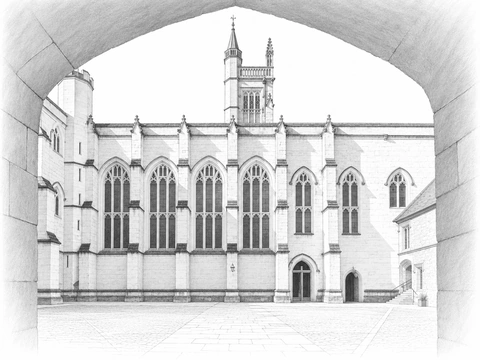
Generated illustration · credits
The reading
Intellectual company is usually spoken of as something in the air. In these papers it looks more like a job, done by particular people: a teacher arranging music for whatever performers were available, a First Folio brought into English classes, a colleague remembered for listening. They are as revealing where the job ran short, in a bursary fund that couldn’t meet demand and in the quieter voices which, a few pupils said in 2023, could go unheard. Any school’s magazine, report or inspection repays the same kind of reading, quick over the adjectives and slow wherever somebody is shown making room for others, or a document admits that the room ran out.
On this page
A leaver and three farewells
Historical account · A 2008 leaver’s reflection and farewell tributes published in 2014
Guy Francis had just left after five years when he wrote about them in the November 2008 Trusty Servant. He arrived suspecting that his Latin scarcely entitled him to the chapel pews his predecessors had warmed, and gathered that each generation of teachers remembered a better generation of pupils, a habit probably as old as teaching. The gap between the reputation and its current holders became a shared joke; belonging partly meant knowing how imperfectly one fitted. He saw the risks of a small world, too. Its rewards could become sufficient in themselves, and a friendship begun over tea or in the queue for a shower could lose its footing outside the routines that held it up. Yet for all his doubts, his strongest case for the education was the Common Room, and the company of particular adults.
The farewells in the 2014 Wykehamist put names to that company. John Falconer turns up in literature, music and house productions, arranging pieces for whatever performers were available – less of a compromise than it sounds, when the alternative is music nobody can play – and his work with community entertainers called for an attentive ear even when the song looked simple. It is a portrait full of pleasure, and it insists, quietly, that pleasure deserves care. The tributes are honest, too, about what close quarters ask of people: Barbara MacKinnon’s acknowledges her discomfort with the exposure of life in a housemaster’s family, and her decision to concentrate on teaching, which is more than most farewells find room for. Philip Nash is remembered for listening, humour and a preference for reason in discipline, a combination most of us would have been glad of at sixteen.
What supports this reading?
Source location: The Trusty Servant 106, pages 2–3; The Wykehamist 1466, pages 26–31
One leaver’s reflection and appreciative colleague tributes; selected historical perspectives.
The College’s accounts
Institutional publication · Reports for the years ending August 2014 and August 2018
The College’s own reports are less romantic. The 2014 report describes a review of the lower years that produced new Div syllabuses, slightly shorter periods and some additional lessons, which is how breadth beyond the examined subjects usually arrives, as a decision about the ordinary week written up in the language of committees. The 2018 report has Shakespeare’s First Folio in use in English classes, medieval manuscripts in history and early scientific books in physics and biology, which a reader of something called Report and Financial Statements may not have expected. Even the Warden’s Stables had been put to work, as the Treasury – in a set of accounts, a word one expects to mean money – serving teaching and public display alike.
The same report has local primary pupils in the laboratories and the nature reserve, and researchers in the archives, though an opening of that kind, with its own purposes and arrangements, is not a place at the school. On places, the College is candid. Bursary provision was substantial, yet demand exceeded the funds available and the College was limiting awards, so that alongside the First Folio and the manuscripts there were children it could not afford to help, and it said so.
What supports this reading?
Source location: 2014, PDF page 11; 2018, PDF pages 12, 16 and 21–23
Institutional reports describing provision and access in these years.
The inspectors
Inspection finding · 21–23 March 2023
Then came the inspectors, in March 2023. Both areas of educational quality were judged excellent, the word a school will quote, though the detail is more use to a reader. The inspectors found a small number of lessons, especially for younger pupils, too dominated by instruction to allow enough exploration of different approaches, which is inspectors’ English, more or less, for a teacher doing most of the talking. Elsewhere they watched pupils use Dante to discuss prisons, a pleasingly specific thing to find in such a report, and listen carefully to one another’s philosophical arguments.
Listening comes up again, less comfortably. A minority of pupils felt the school did not hear their views, and the inspection evidence partly supported the concern: a few said that quieter voices could go unheard despite the channels available. Channels, as anyone who was once a quiet pupil will remember, tend to work best for the people who need them least. The finding is dated, and partial, but it sends a reader back to Francis, and to teachers who each remembered a better generation of pupils than the one in front of them. Perhaps the better generation is always the one that got a word in.
What supports this reading?
Source location: ISI, educational quality: achievement, learning and pupil voice; exact paragraphs in source notes
Dated inspection findings; they cannot show current provision.
Independent Schools Inspectorate, Winchester College, March 2023
Sources and limits
Original publications consulted
- The Trusty Servant, November 2008, pages 2–3 · archived public originalConsulted
- The Wykehamist, Common Time and Cloister Time 2014, pages 26–31 · archived public originalConsulted
- Winchester College, Report and Financial Statements, 31 August 2014 · archived public originalConsulted Open the original
- Winchester College, Report and Financial Statements, 31 August 2018Consulted
- Independent Schools Inspectorate, Winchester College, March 2023Consulted
- A leaver’s reflection, colleagues’ affectionate tributes, the College’s own reports and an inspection are different kinds of evidence. Their particular observations cannot fix an unchanging school character, or speak for every pupil’s experience.
- We checked the passages in retained copies of the public originals. Archive and school PDF links may no longer work; this is a reading of dated sources, not an assessment of what the school provides now.
About this essay
Written by The Schools Record from the sources identified above. The earlier research listed below helped us find the questions and passages to examine.
- The Trusty Servant, no. 106, November 2008 · pages Guy Francis, Reflections on Five Years at Winchester, pages 2–3.
- The Wykehamist, no. 1466, Common Time and Cloister Time 2014 · pages John Falconer, Barbara MacKinnon and Philip Nash farewell tributes, pages 26–31.
- Winchester College, Report and Financial Statements, 31 August 2014 and 31 August 2018 · pages 2014: PDF page 11, printed page 9. 2018: PDF pages 12, 16 and 21–23, printed pages 10, 14 and 19–21.
- Independent Schools Inspectorate, Winchester College, March 2023 · pages Inspection on 21–23 March 2023; report dated 28 April 2023. Sections 3.1–3.3, 3.6–3.7 and 3.18.
Reviewed for this edition on ; next review by . That review covers this reading of the cited evidence. It does not mean that every original historical publication has been checked again.
Read corrections and unresolved publication differences
Where next