Questions · St Paul’s
St Paul’s School and the social life of an idea
Schools like to say they prize curiosity. At St Paul’s, a schoolboy’s history magazine and a small pile of drier papers suggest what the claim can amount to.
Covers: An interpretive portrait drawn from a retrospective account of the 1980s, school documents from 2015 and 2025, public teaching statements consulted in September 2026 and the January 2025 inspection. A remembered episode, or a school’s statement of its intentions, cannot tell you what every pupil experiences now.
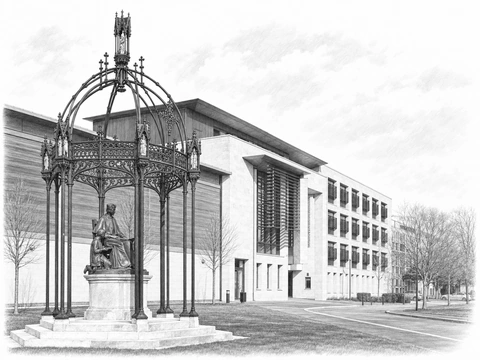
Generated illustration · credits
The reading
Of all the material on St Paul’s gathered here, the most revealing concerns something a pupil started. In Janan Ganesh’s account of George Osborne at the school in the 1980s, history came with its own occasions for talk, among them a society, which somebody had to run. Osborne eventually did, and launched its magazine, which carried interviews with historians.1 That is what curiosity looks like when somebody acts on it: an interest that finds an audience, then a project and in time some responsibilities. It suggests a test for a family reading any school’s account of itself, which is to look past the adjectives for occasions like these and then to ask how a boy who isn’t yet sure of himself finds his way into them.
On this page
The company a subject keeps
Ganesh’s chapter is called “History Boy”, and he sets the school in the metropolitan professional London of the 1980s. The tutorials were discursive, which is praise in a tutorial and usually a warning in an essay, and pupils delivered papers of their own. But the magazine is the detail to linger over. Reading a historian is one thing and thinking of something worth asking one is quite another. A pupil has to work out what the argument is and which part of it needs explaining before he risks a question of his own, trusting that published historians, like the rest of us, can be asked to explain themselves.1
In Ganesh’s telling the company is as interesting as the curriculum. Teachers had particular enthusiasms and contemporaries were willing to talk about them, and there were visiting speakers, too, who could be met at close quarters. Between them they make a better account of that most elusive of school words, atmosphere, than a prospectus usually manages, since what it comes down to is whether a pupil will find people to talk to.1
The next document belongs to a genre read almost entirely by people who want the job. In November 2015 the school was recruiting a teacher of Classics for the autumn of 2016, and its particulars described pupils and staff using JSTOR, teachers publishing books and translations, and societies at which boys, teachers and visitors spoke. A school writing to the colleagues it hopes to hire is selling itself a little, of course, but the picture is of adults with work of their own on the go, so that a boy could see the subject as something people carry on doing once nobody is examining them in it. Established teachers were expected to become tutors as well, responsible for particular pupils.2
The school’s website sounds the same notes. Its pages are undated, so we can say when we read them, in September 2026, and not when the school wrote them. History pupils, it says, are encouraged to develop their own questions and an Archive Society undertakes original research, and the page on teaching and learning sets listening and reflection beside argument – sensibly enough, since an exchange in which nobody listens to the answer is really two speeches. This is the school’s account of what it intends and provides, and as we made no visits, none of it is something we saw.3,4
The inspectors who came in January 2025 were not describing themselves, which is what makes their report worth having beside the rest. They found warm relationships between teachers and pupils, intellectual curiosity and respectful behaviour, and named the extracurricular programme as a particular strength, which after so many societies is the finding one would most want confirmed by somebody else. They also found that PSHE in the senior school did not consistently engage pupils, which in plain English means that some of the time it didn’t, and that belongs in the account as surely as the praise.5
Expecting to be heard
None of this appears in a results table. Aaron Reeves and Sam Friedman’s Born to Rule (2024) explores how elite schooling can help make consequential work feel imaginable and within reach, drawing on a group of schools that includes St Paul’s, though it is no ethnography of this school today. It does catch what the table misses, which is that access to accomplished adults, an audience for one’s interests and practice in expecting to be heard may all shape a person’s sense of what they can attempt.6 A boy who has put a question to a historian and had it answered has had some of that practice already.
Then there is the matter of paying for it. The Founder’s Awards policy supplied to us, authorised in November 2025, has “Awards” in its title and very little of the prize-giving about it, since once a pupil has joined, his performance and behaviour have no bearing on the award. The family’s finances are reviewed each year and the award can change. There are eligibility conditions, too, and decisions left to discretion, but the money is not described as a prize that a boy must keep winning with his marks. That is a narrower point than the familiar claim that bursaries make a school socially open, and a more exact one.7
A prospective pupil reading all this might reasonably ask how anyone begins. Most of what these papers describe happens once a pupil is already talking. They say a good deal less about the boy who enjoys a subject but isn’t ready, just yet, to say anything about it in front of a room. Perhaps the magazine holds a clue. What it carried were interviews, and an interview is the one kind of conversation in which the person asking the questions is supposed to do most of the listening.
What this portrait rests on
Everything here is our reading of what other people wrote down. We made no visits and interviewed nobody, so the school appears only as it appears on paper, and this is not a complete history of it. The 1980s schoolboy belongs to a biography, and is not offered as a picture of the school’s pupils now. We read the saved preview pages of Ganesh’s biography and the relevant passages of Born to Rule, neither in full. What we say about the magazine is our own reading, and it puts no invented words into the mouths of Osborne or his contemporaries and imputes no private motives to them.
- Janan Ganesh, George Osborne: The Austerity Chancellor, chapter 2, “History Boy”. The actual pages in a saved Google Books preview were consulted: PT18, PT19 and PT20, with PT16 and PT17 read for preceding context. These identifiers are preview locators, not printed page numbers. This is a partial preview, not a reading of the complete book.
- St Paul’s School, Teacher of Classics, Starting Autumn 2016. Recruitment particulars dated November 2015, PDF pages 1–2, supplied to TSR. This is a school-authored document describing the department at that time. It is not a current staffing, timetable or participation statement. No public copy is linked here.
- St Paul’s, History. Public page consulted 30 September 2026. School-authored account; no publication date established.
- St Paul’s, Teaching and Learning. Public page consulted 30 September 2026. School-authored account; no publication date established.
- Independent Schools Inspectorate, St Paul’s School, 14–16 January 2025. Especially PDF pages 3–4 and 7–9. This is a separate, more recent source than the 2017 compliance report. Its findings describe the inspection period.
- Aaron Reeves and Sam Friedman, Born to Rule (2024). Chapter 5, especially pages 127–141 of the supplied PDF edition. The link is a public bibliographic record. The confidence and intellectual-independence themes come from pooled historical discussion and alumni interviews, with several examples concerning other schools. References to Shamus Khan’s research on St Paul’s concern the United States school, not London.
- St Paul’s School and St Paul’s Juniors, Founder’s Awards (Bursary) Policy. Supplied policy authorised November 2025; especially PDF page 4, section 6, paragraphs 7–8, and section 8. The stated next review was June 2026. This essay describes the supplied edition and does not assert that it is the latest policy or offer individual eligibility advice. No public copy of that edition is linked here.
The companion essay, St Paul’s in reflective nonfiction, sets this portrait among a wider reading of memoirs, biographies and institutional accounts, and keeps the passages we have consulted apart from books whose relevant chapters are still to be read.
Sources and limits
Original publications consulted
- Janan Ganesh, George Osborne: The Austerity Chancellor · Google Books preview, chapter 2, History BoyConsulted
- St Paul’s School: History · undated public teaching accountConsulted
- St Paul’s School: Teaching and Learning · undated public statementConsulted
- ISI: St Paul’s School, 14–16 January 2025 · especially PDF pages 3–4 and 7–9Consulted
- Aaron Reeves and Sam Friedman, Born to Rule (2024) · public bibliographic recordConsulted
- An original interpretation of attributed historical accounts, institutional documents and a dated inspection. The Schools Record conducted none of the visits or interviews described, and this is not a complete history of the school.
- We read the relevant preview pages of the Ganesh biography and the relevant passages of Born to Rule, not either book in full. Born to Rule pools its evidence across elite schools and is not a study of this school today. The St Paul’s in Shamus Khan’s research is the school in the United States, not the one in London.
- The school’s teaching statements describe its intentions and provision, and the inspection describes its own period. Neither can show an individual pupil’s experience, or what difference the school itself makes.
- The bursary discussion concerns the November 2025 policy supplied to us, which gave June 2026 as its next review. We do not claim it is the latest version, and nothing here is advice on an individual family’s eligibility.
About this essay
Written by The Schools Record from the sources identified above. The earlier research listed below helped us find the questions and passages to examine.
- Janan Ganesh, George Osborne: The Austerity Chancellor · chapter 2, History Boy · saved Google Books preview · pages PT18–PT20; preceding context PT16–PT17. Preview locators, not printed page numbers.
- St Paul’s School, Teacher of Classics, Starting Autumn 2016 · recruitment particulars dated November 2015 · pages PDF pages 1–2
- Aaron Reeves and Sam Friedman, Born to Rule (2024) · selected Chapter 5 passages · pages Supplied PDF pages 127–141
- St Paul’s School and St Paul’s Juniors, Founder’s Awards (Bursary) Policy · authorised November 2025 · pages PDF page 4, sections 6.7–6.8 and 8
Reviewed for this edition on ; next review by . That review covers this reading of the cited evidence. It does not mean that every original historical publication has been checked again.
Read corrections and unresolved publication differences
Where next